

Quick Answer
The easiest way to learn how to drift in FR Legends is to use on-screen buttons, pick a balanced rear-wheel-drive car, and practise one wide corner slowly. Brake in a straight line, turn in, tap the handbrake briefly to start the rear sliding, steer the opposite way, then feed the throttle gently to hold the slide. Look toward the exit and ease off as the car straightens. Small inputs beat full lock and full power.
Choose Controls You Can Repeat
Drifting is mostly timing. A good control layout lets you reach steering, throttle, brake and handbrake without thinking about where they are. Most new players learn fastest on buttons, not because buttons are magic, but because every input is clear. You can tap a correction instead of swinging the car by accident.
On-screen buttons: the easiest place to start
Buttons give you the cleanest first week. Hold a turn with one thumb, tap the opposite button to catch the slide, and notice how long each tap changes the angle. Keep the handbrake where your thumb reaches it without changing your grip. If you keep missing the brake or hitting throttle by mistake, move or resize the controls before blaming your technique.
On-screen wheel: smooth, but easier to overdo
The wheel can feel natural once you understand counter-steering, because you can hold a middle position instead of tapping left and right. The beginner problem is turning too far and staying there after the car has responded. If you use the wheel, move slowly and bring it back toward the centre as soon as the nose points where you want to travel.
Tilt: fun, but the hardest to make consistent
Tilt works, and some players are quick with it, but a small wrist movement can become a big steering change when a slide starts. Hold the phone the same way every run and avoid steering from the elbows if you choose tilt. For learning the basic sequence, buttons give you fewer surprises.
Set sensitivity for control, not drama
If your version shows a steering sensitivity option, start around the middle of the range as a practical starting point. Very high sensitivity makes the car dart, while very low sensitivity can make you late when the rear steps out. Change it in small steps, run the same corner three or four times, and only keep a change if your exits become calmer.
Simple control check: drive one corner slowly without drifting. If you cannot hold a smooth line at normal speed, fix your grip, layout or sensitivity first. A drift only magnifies the problem.
Start With a Forgiving Car, Not the Fastest One
Your learning car should be rear-wheel drive, stable at low speed and not so powerful that a tiny throttle press throws it at a wall. A calm car shows you what your hands did. A very powerful car can hide a good entry with a sudden snap at the exit.
Stay with one car while you learn. Switching every ten minutes resets your feeling for entry speed, steering angle and throttle response. If you are still choosing a starter, our FR Legends car list with beginner-friendly starter cars helps you compare the garage before you tune the wrong machine.
Basic Tuning That Helps a Beginner Drift
Tuning should make the car easier to read, not turn it into a new puzzle every run. Start close to the standard setup, make one small change, and test it on a corner you already know. If you cannot say what changed, the change was too big or you changed too much at once.
Tires and grip balance
Think of grip as how willing each end of the car is to slide. If the rear feels glued down, the car may refuse to start a drift without a big handbrake pull. If the rear feels loose all the time, it starts easily but keeps rotating. Keep the balance near standard as a starting point. Need an easier start? A little less rear grip can help the tail move. Spinning every time? Give the rear a little more stability and check your throttle hand first.
Camber and steering angle
Camber changes how the tire sits against the road as the car turns and leans. Leave it near the default while you learn the sequence. Large changes can make grip arrive or disappear halfway through a corner, which is hard to read when you are still learning counter-steer. Steering angle is different: more angle can help catch a bigger slide, but it can also tempt you to hold full lock too long. Start with the standard angle, catch the car earlier, and only add a small amount later if you truly need it.
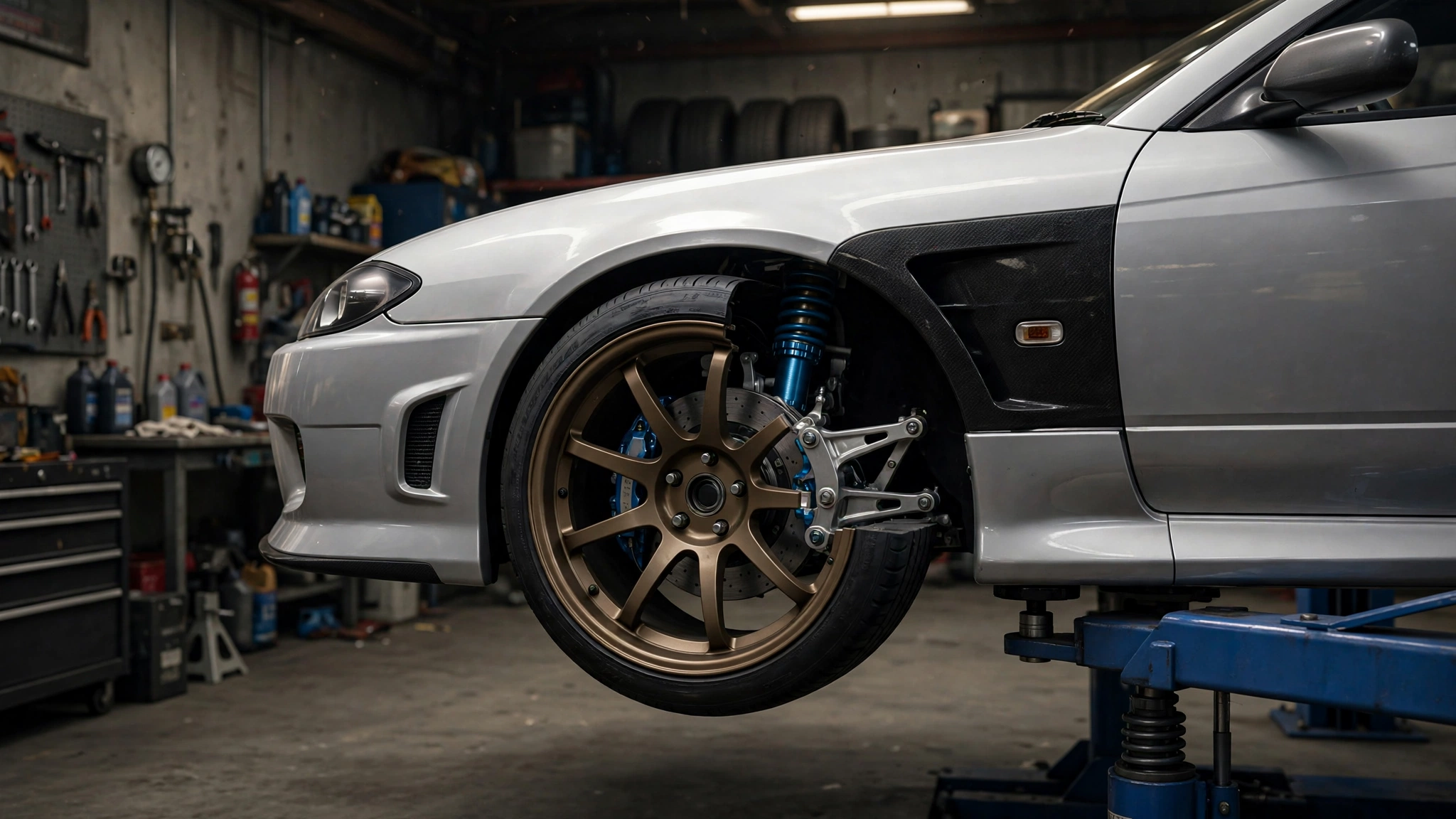
Gears, power and throttle response
You do not need maximum power to learn. A softer response makes the middle of a drift easier. Pick a gear that keeps the engine pulling without constantly hitting the limiter or falling asleep. If the car bogs down, the gear is too high. If the wheels scream and the car keeps rotating, the gear may be too low or your throttle press is too long. Treat gear choice as practical advice for each corner, not a fixed rule. Leave power upgrades alone until the same corner works five times in a row. More power does not fix a late handbrake. It turns a small mistake into a quicker spin.
One-change rule: change one item, run the same corner five times, then decide. If it feels better twice and worse three times, go back. Your hands are part of the setup, so give them time to adapt.
Your First Drift, Step by Step
Pick one wide, slow corner and repeat only that corner. Do not start with a tight hairpin, a fast sweeper and a transition in the same run.

Set up wide and settle the car
Approach from the outside at a speed that feels almost too slow. Keep the car straight, choose your gear, and finish braking before you turn. A calm entry gives you time to watch the rear instead of panicking at the wall.
Turn in toward the apex
Steer toward the inside with one clear movement and aim the nose at the apex, the innermost part of the turn. This tells the car where the drift should go. Wandering in with tiny steering movements starts the slide late and messy.
Tap the handbrake to start the slide
As the car turns, tap the handbrake briefly, then release it. You are asking the rear to step out, not parking the car sideways. A short tap is enough at beginner speed. Holding it too long kills momentum and rotates the car around its front wheels.
Catch it with counter-steer
The moment the rear moves, steer the opposite way. If the corner goes right and the tail swings left, steer left to catch it. Start earlier than you think, but do not throw the steering to full lock. Point the front wheels roughly where you want to travel: toward the exit.
Feed the throttle and balance the angle
Add throttle in a smooth squeeze. More throttle usually increases the slide and pushes the car wider, while easing off reduces angle. If the car keeps rotating, ease off and unwind some steering. If it straightens too soon, add a little throttle and hold your catch a moment longer.
Unwind, straighten and drive out
As the corner opens, look at the exit and bring the steering back toward centre while the slide reduces. Do not snap both inputs off at once. When the rear grips again, the car should already point down the next straight. A clean, quiet exit matters more than a huge angle.
Repeat the same sequence until it feels boring. Boring is good. It means your hands have learned the order: brake straight, turn in, brief handbrake, counter-steer, gentle throttle, unwind. Once that order is automatic, carry a little more speed or try a longer corner.
Why You Keep Spinning Out
A spin is usually the car answering one input that arrived too late, lasted too long, or was much bigger than the others. It is not a mystery, and it does not mean you are bad at the game.
You entered too fast
Cause: more speed than your steering and throttle can manage, so the rear keeps rotating. Fix: brake earlier for five runs, enter almost slowly, then add pace after two clean exits in a row.
Your counter-steer was late
Cause: you waited until the slide looked big, and the car had already chosen to spin. Fix: steer opposite as the rear first moves. Early and small beats late and huge.
You held full lock too long
Cause: maximum opposite steering stays on after the car has caught, swinging it back the other way. Fix: point the front wheels where you want to travel and unwind as the angle reduces.
You stood on the throttle
Cause: a long full-throttle press keeps the rear wheels spinning and grows the slide past what you can hold. Fix: squeeze and ease in short changes. If the angle keeps growing, check your throttle thumb first.
You panicked off the throttle or braked mid-slide
Cause: sudden lifting or braking shifts the car and can snap it straight or spin it. Fix: reduce throttle gradually while unwinding the steering, and brake hard only when the car is mostly straight.
You corrected three times for one slide
Cause: especially with tilt or the wheel, each new correction starts another swing. Fix: make one clear catch, hold it for a breath, then adjust. If every run feels twitchy, return to buttons for a short session.
How to Practice Without Building Bad Habits
Good practice is short, specific and a little repetitive. Choose one car, one layout and one easy corner for ten minutes. Your only score is clean exits. Five calm exits teach more than thirty wild attempts that end in the fence.
Use a ladder. Drive the corner normally until the line is smooth. Add only the handbrake tap and straighten early. Hold a small slide to the exit. Carry a touch more speed. Move up only when the previous step works most of the time, and go back a step when it falls apart instead of changing the tune.
For that routine, pick a layout with room for mistakes from our guide to FR Legends tracks that are good for beginner practice, especially a circuit-style map where the same corner comes around quickly. Wide corners and predictable laps make one run easy to compare with the next.
Keep the game responsive while you practise. If the picture stutters or inputs feel delayed in solo runs, fix that before judging your hands by following our guide to making FR Legends run smoother on low-end phones. Smooth practice makes your timing honest.
End each session by naming one thing that improved and one thing for next time, such as calmer entries but snappy exits. That small note stops the next session becoming random driving with a new setup and no lesson carried over.
FAQs
Which control is best for drifting in FR Legends: buttons, wheel or tilt?
Buttons are the easiest start for most beginners because corrections are clear and repeatable. The wheel can feel smoother later, while tilt is fun but sensitive to small hand movements. The best control is the one you use the same way on every run.
Do I need to use the handbrake for every drift?
No. The handbrake is a simple way to start a slide at beginner speed, but speed, steering and throttle can start some drifts later. Learn the handbrake method first because it gives you a clear starting point.
Why does my car spin 180 degrees as soon as I drift?
Usually the entry was too fast, the handbrake was held too long, counter-steer came late, or throttle stayed down while the angle grew. Slow down, tap the handbrake briefly, steer opposite earlier and squeeze the throttle.
Should beginners use automatic or manual gears while drifting?
Use whichever lets you concentrate on steering and throttle first. With manual gears, choose one that keeps the engine pulling without bouncing on the limiter. A calm entry and early catch matter more than the gear mode.
Do I need a powerful car to hold a long drift?
No. A balanced rear-wheel-drive car with predictable throttle is easier to hold sideways than a very powerful build. Long drifts come from entry speed, angle and small throttle changes. Add power after your exits are clean.
How long does it take to learn the first clean drift?
It varies, but the first clean slide usually comes after enough repeats on one corner for the order to feel normal. Chase five calm exits on the same corner, not a deadline. Changing cars, controls and tunes every session makes it take longer.
Conclusion
Your first good drift will probably look small, and that is right. Choose buttons, keep one forgiving car close to its standard setup, enter slowly, tap the handbrake, catch the slide early and unwind with care. Take that routine to a wide layout from our FR Legends track list for beginner practice and repeat it until clean exits feel normal. Angle comes later. Control comes first.